
Can I Claim Expenses Travelling to Work if I am Self-Employed?

By Rachael Anderson

18 April 2026

Expenses

7 mins

There are many benefits to self-employment such as job satisfaction, a good work/life balance, and creative freedom. But the true reality of your business is your profits.

Profits are important, helping you to fund the growth of your business, and providing you with the money you need to pay your bills and enjoy yourself. They’re also important because you pay your tax bill based on how much profit you make.

You can figure out your taxable profits by deducting allowable expenses, but the rules around what qualifies can be confusing, especially when it comes to things like travel. So in this article we’ll focus on travel expenses in particular.

What are allowable expenses?

An allowable expense is simply a cost (or expense) you’ve incurred while running your business. These expenses can be offset against your tax bill, so you’ll claim tax relief for them and reduce the amount of tax you need to pay.

What can I claim as an allowable expense in the UK?

There are lots of things you can claim as an allowable expense – as long as the expenses are exclusively for your business. For example, you can claim expenses for uniforms, but not for your Christmas work party outfit. The most common types of expenses include:

  • Property, equipment, and offices
  • Travel expenses
  • Uniforms and clothing materials used for work
  • Marketing
  • Training courses

Is traveling to and from work classed as an expense?

The short answer is no. You can’t claim any tax relief traveling to or from work as part of your usual commute unless you’re traveling to a temporary place of work. You might sometimes see this referred to as the 24-month rule.

What counts as a temporary workplace? The 24 month rule for travel expenses

Your workplace will be considered permanent rather than temporary if:

  • You spend more than 40% of your working time at that workplace
  • You’re likely to attend the workplace over a period lasting longer than 24 months

If you meet the ‘temporary workplace’ rules then you’ll be able to claim your travel expenses. But, if you don’t, then you won’t be able to.

For example

You start a contract which is 12 months long, so you reasonably expect this to be a temporary workplace. It’s fine to claim the travel costs.

If the contract is 30 months then you’ll be over the 24 month limit. You won’t be able to claim any of the travel costs. Not even the first 24 months of them.

What travel expenses can I claim for?

If you travel a lot for work but it isn’t part of your normal commute, you can claim tax relief on things such as:

  • Public transport
  • Hotel accommodation (if you’ve had to stay overnight anywhere for work)
  • Food and drink
  • Congestion charges and tolls
  • Parking fees
  • Business phone calls or printing costs (i.e. to print out your plane tickets)
  • Business mileage

The key here is that everything you claim for must be exclusively for your business.

So if, for example, you’re a photographer working on the other side of the country for a couple of days and need to book accommodation for the night, you’ll be able to claim tax relief on the cost. You wouldn’t be able to claim any relief if you booked a couple of nights away as a family holiday.

Can I claim travel expenses if I forgot to include them last year?

You’re able to claim expenses for the current tax year and the 4 previous tax years (as long as you haven’t already claimed them on an earlier tax return!).

This means you might still be able to claim tax relief if you have unclaimed expenses from previous tax years. If a journey is for both business and personal reasons – double-check with your accountant to see if it qualifies.

What type of journeys can I claim travel expenses for?

You can only claim for journeys that are outside of ‘ordinary’ commuting (which is where that 24 month rule we mentioned earlier comes in). Beyond that, you can claim for pretty much any business journey, but HMRC do expect business owners to be ‘reasonable’. Which will make you raise an eyebrow if you’ve ever spent an unreasonable amount of time on hold with them.

Reasonable travel expenses means you’ll need to take the most sensible mode of transport. You can only claim that helicopter trip if you can demonstrate it’s in the business’s best interests for you to travel that way.

How do I record my travel expenses?

It’s useful to keep a detailed log which shows the purpose of each trip and the dates you travelled so you can match this information to your receipts. If you enter your receipts into Pandle (subtle mention) then you can attach them to the relevant transaction in your bank records, and add a note to remind yourself which trip they relate to.

How do I work out travel expenses if I use my own vehicle?

If you’re self-employed and use your own vehicle for work purposes then you can either claim the actual cost of running your vehicle, or use ‘simplified expenses’. It’s up to you which one you use as long as you’re consistent in using the same method on each tax return.

With that in mind, it might be worth working out which method is most tax efficient for your business.

Working out your actual vehicle costs

To calculate your actual vehicle costs you’ll need to record all the expenses which relate to your vehicle, and then work out the proportion which relates to your business. For example, your costs might include:

  • Fuel
  • Hire charges
  • Insurance
  • Repairs and servicing
  • Vehicle license fees
  • Breakdown cover

Using simplified expenses

Rather than working out the actual cost of running your vehicle, you also have the option of using ‘simplified expenses’. With this method you’ll multiply the number of business miles you travel by the flat rate which relates to your type of vehicle.

Just keep in mind that this isn’t an option if you’ve already claimed capital allowances on your vehicle).

Simplified expenses can only be used by sole traders and individual business partners.

You can use simplified expenses for cars (except ones designed for commercial use, for example, black cabs), motorcycles, and goods vehicles such as vans. The flat rate you can claim depends on what type of vehicle you use:

Vehicle type

Cars / goods vehicles (first 10,000 miles)

Cars / goods vehicles (after 10,000 miles)

Motorcycles

Flat rate per mile

45p

25p

24p

How do I claim travel expenses?

This is where excellent record keeping will help! Log every business journey you take throughout the year, ensuring you don’t include any personal mileage. It’s up to you how you record these, such as with a dedicated mileage tracker tool, or updating a spreadsheet as you go.

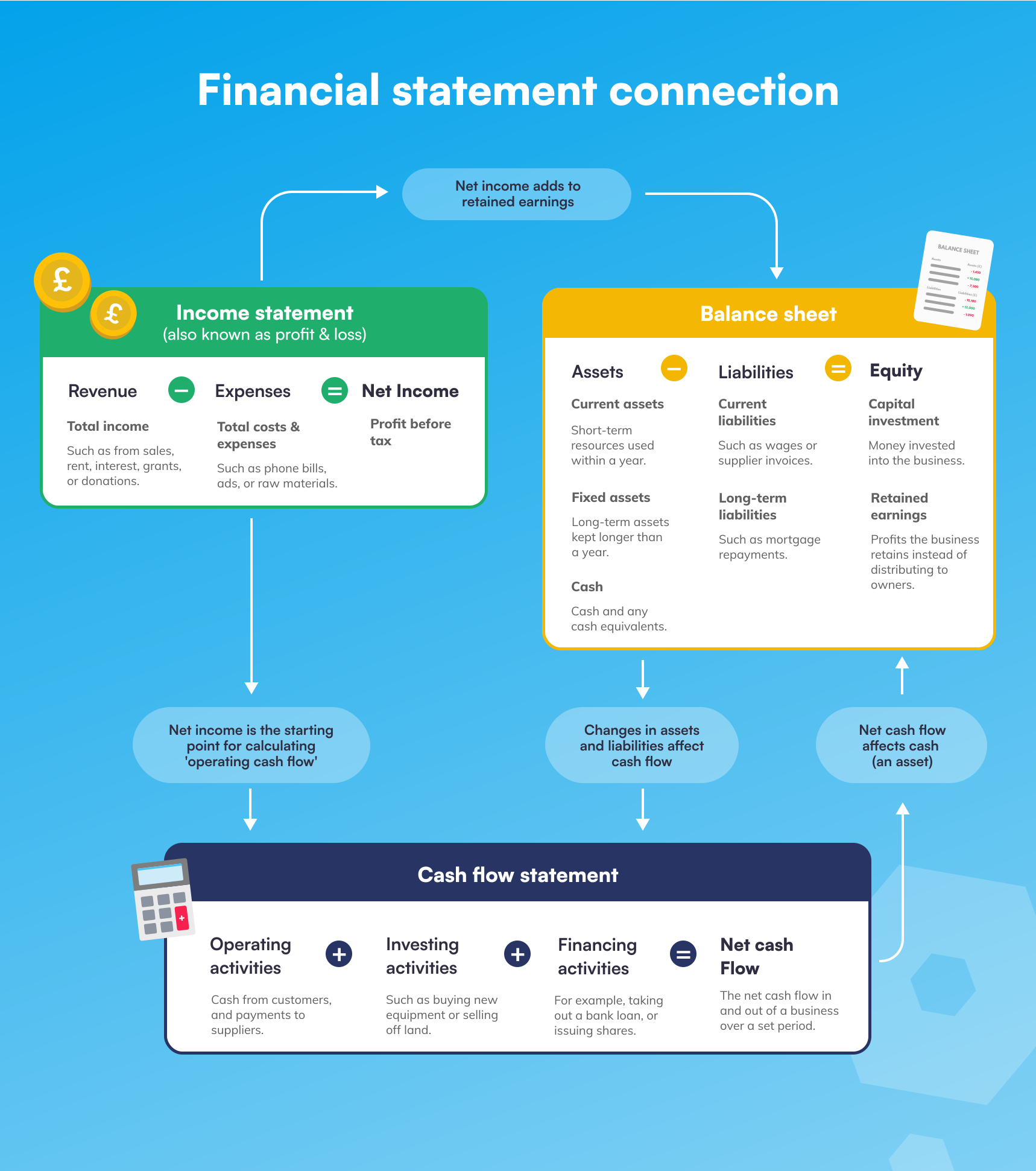
The diagram below shows how recording your expenses correctly affects other areas of your business.

Once you calculate your travel expenses, you can add them to any other expenses you’re claiming tax relief for, and include them in your tax return.

Learn more about using Pandle to make business accounting easier. Create an account today and decide what to do with all the extra time you get back.

Rachael Anderson

A creative content writer specialising across business, finance and software topics. I have a love for all things writing, and creating engaging, easy to understand content that helps everyday people!

Subscribe
Notify of
guest
0 Comments
Oldest
Newest Most Voted
Inline Feedbacks
View all comments

Get started with Pandle

Create your account today, and decide what to do with all the extra time you get back. We hear Pilates is popular.

Live chat support

No card details required

Making Tax Digital compliant

Live chat support

No card details required

Making Tax Digital compliant